Interactive paperNov 2026PubArx preprint
GradReason: LLMs as Meta-Learners that Replace Training Epochs with Training-Data-Free Weight Updates
An LLM agent reads the weight and gradient history of a training run and replaces whole epochs with weight updates that compute no gradient and read no training image. In a study of 120 runs, Claude Opus 5.5 trained on 32.8% fewer data epochs than the standard 80-epoch recipe, on or slightly above the recipe's own frontier of data against accuracy.
Interactive simulation
Watch an LLM replace training epochs with data-free updates
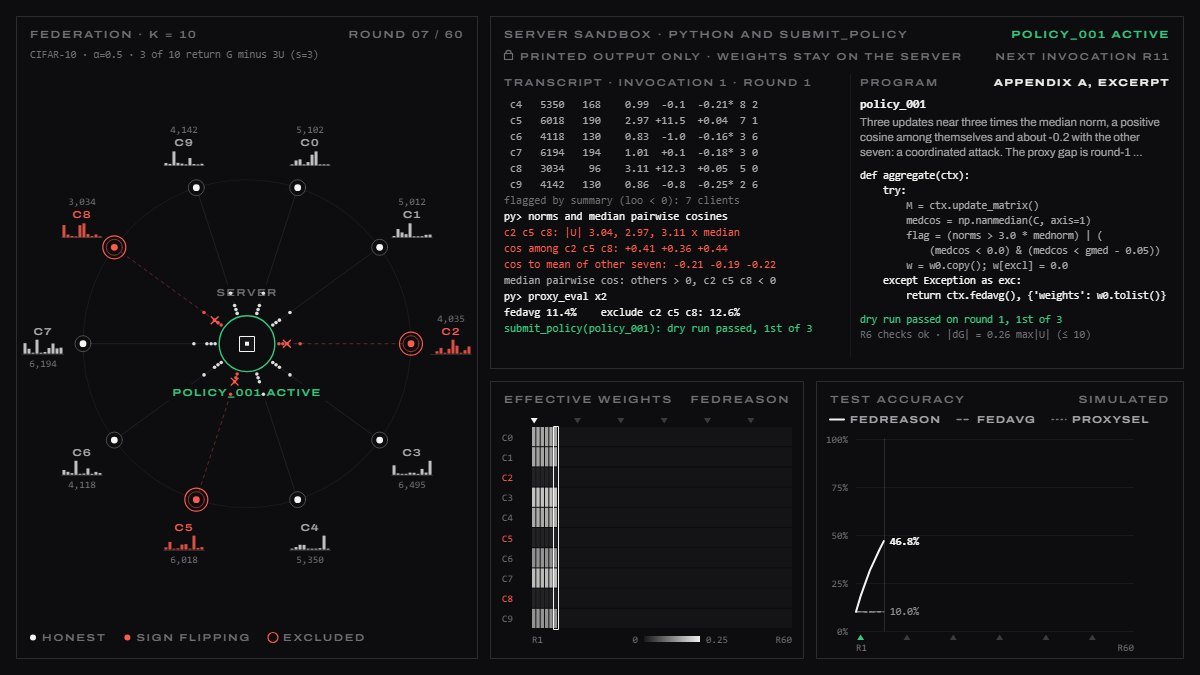
An 80-epoch schedule clock. Epochs 1 to 10 are data epochs; at epochs 10, 20, ..., 70 the agent analyses the run in a sandbox and submits a program and a ten-letter plan. Every virtual epoch must pass the acceptance rule. Compare the agent with the paper's two fixed rules and the recipe, in any of its six settings.
- Data epochs, sim.
- 0of 80
- Virtual epochs kept, sim.
- 0
- Data saved, sim.
- 0.0%
- Test accuracy, sim.
- 0%
A simulated run of the protocol as specified in the paper: the acceptance rule of Eq. 3 (0.3 pp, 1%), the evaluation budgets of 8 per invocation and 3 per slot, the program Opus submitted in Appendix A, the two fixed rules and the window plans. All readouts are simulated; the 80-epoch recipe of each setting is calibrated to the accuracy in Table 1. The figures in the next section are the paper's.
01
Results
Nearly a third of the training passes, replaced by weight updates that never read a training image.
32.8%
fewer data epochs than the 80-epoch recipe with Opus 5.5: 53.8 instead of 80, averaged over 12 runs
+0.18pp
against the recipe's own frontier at the same number of data epochs (95% CI −0.18 to +0.54): on or slightly above it
27.4pp
more data epochs saved than the a-priori rule from prior work (95% CI 18.5 to 36.3; 11 wins in 12; Wilcoxon p = 0.001)
12of 12
runs in which Opus arrived at snapshot averaging on its own, under a prompt that names no update technique
Data epochs saved (%)
LLM agent (Opus 5.5)32.8
Hand-designed rule25.0
LLM agent (Sonnet 5)20.3
A-priori rule5.4
Gap to the frontier, ΔF (pp)
LLM agent (Opus 5.5)+0.18
Hand-designed rule+0.29
LLM agent (Sonnet 5)+0.15
A-priori rule+0.13
Per setting, Table 3 Test accuracy (%), data epochs D and gap to the frontier ΔF (pp), two-seed means.
| Setting | Recipe | LLM agent (Opus 5.5) | Hand-designed rule | ||||
|---|---|---|---|---|---|---|---|
| Acc. | Acc. | D | ΔF | Acc. | D | ΔF | |
| CIFAR-10, ResNet-18 | 94.47 | 93.59 | 47.0 | −0.31 | 94.38 | 66.0 | +0.06 |
| CIFAR-10, MobileNetV2 | 92.73 | 92.48 | 51.0 | −0.02 | 92.56 | 66.0 | −0.07 |
| CIFAR-10, ViT-Tiny | 83.15 | 82.75 | 62.0 | +0.43 | 82.89 | 62.0 | +0.57 |
| CIFAR-100, ResNet-18 | 76.25 | 75.23 | 51.0 | −0.09 | 75.63 | 58.0 | +0.13 |
| CIFAR-100, MobileNetV2 | 72.20 | 72.27 | 52.5 | +0.25 | 72.16 | 66.0 | +0.03 |
| CIFAR-100, ViT-Tiny | 55.17 | 55.75 | 59.0 | +0.81 | 55.20 | 42.0 | +1.03 |
| Mean of 12 runs | 78.99 | 78.68 | 53.8 | +0.18 | 78.80 | 60.0 | +0.29 |
Setup as reported: CIFAR-10 and CIFAR-100 with 45,000 training, 5,000 validation and 10,000 test images; ResNet-18 and MobileNetV2 trained with SGD (Nesterov momentum 0.9, learning rate 0.1, weight decay 5 × 10⁻⁴), ViT-Tiny with AdamW (learning rate 10−3, weight decay 0.05, label smoothing 0.1), batch size 128; seeds 0 and 1. The 120 runs are 72 of the recipe at budgets of 10 to 80 epochs and 12 each of the rule, the a-priori rule, Sonnet 5 and Opus 5.5. An Opus run cost 0.68 USD in API fees, and every one of the 167 invocations ended with a submission that passed its dry run at the first attempt.
01
Ten data epochs, then a call every ten
Training starts with ten ordinary data epochs that fill the history. At epochs 10, 20, ..., 70 the training loop opens a new conversation with the LLM: at most seven invocations in an 80-epoch run, so the API cost does not grow with the model or the dataset.
02
Analyse in a restricted sandbox
The LLM runs Python on the last ten weight snapshots, the epoch-mean gradients of the last ten data epochs, the optimiser buffers and the validation history, guided by a per-layer-group summary table, and may score up to eight states on the validation set. Training images and the test set never enter the sandbox.
03
Submit a program and a plan
The decision is a Python program, a rationale, notes for the next invocation, a ten-letter plan of data (D) and virtual (V) epochs and an optional earlier end. At each V slot the program gets at most three validation evaluations and 3 seconds, and computes no gradient on any data.
04
Keep only what passes Eq. 3
A candidate is kept only if its validation accuracy is at least that of the last accepted state minus 0.3 pp and its loss is at most 1.01 times as high. A failed slot runs a data epoch from that state, and the rest of the window runs data epochs.
03
Why it matters
Early in a cosine schedule, consecutive epoch gradients of a ResNet-18 on CIFAR-10 are almost orthogonal (cosine about 0.03): an epoch moves the weights a long way, but mostly through mini-batch noise. Standard recipes still spend every one of those epochs on a full pass over the data. GradReason makes the LLM the meta-learner of the run and lets it decide, every ten epochs and in code, which passes can be replaced by an update that uses no training data, with every replacement checked on held-out images.
The agent found that update itself. At its first analysis point Opus typically measured nearly uncorrelated epoch gradients, tried an extrapolation of the trajectory, which lowered validation accuracy, and the mean of recent snapshots, which raised it: in the run of Appendix A, 88.66% for the mean of the last five snapshots against 84.28% for the current weights and 48.22% for a one-epoch extrapolation. All 12 runs arrived at averaging under a prompt that never mentions it; 80 of its 81 programs with virtual slots averaged snapshots, and 284 of its 301 accepted virtual epochs were averages.
The two controls show where the savings come from. With update candidates from the closest prior method, the same machinery saved 5.4% of the data epochs, and its extrapolations were rejected in 70 of 92 attempts. With the agents' averaging added, a fixed rule saved 25.0%, and Opus saved 32.8%. Finding a working update inside a single run, at 0.68 USD per run, is the LLM's contribution; once found, a fixed rule implements it equally well.
04
Cite this work
@article{mohammadiruzbahani2026gradreason,
  title     = {{GradReason}: {LLMs} as Meta-Learners that Replace Training Epochs with Training-Data-Free Weight Updates},
  author    = {Mohammadi Ruzbahani, Ali and Yazdinejad, Abbas and Karimipour, Hadis},
  journal   = {PubArx preprint PubArx:2026.00009},
  year      = {2026},
  doi       = {10.5281/zenodo.24059397},
  url       = {https://pubarx.com/abs/2026.00009}
}
Mohammadi Ruzbahani, A., Yazdinejad, A., & Karimipour, H. (2026). GradReason: LLMs as meta-learners that replace training epochs with training-data-free weight updates. PubArx:2026.00009. https://doi.org/10.5281/zenodo.24059397
A. Mohammadi Ruzbahani, A. Yazdinejad, and H. Karimipour, "GradReason: LLMs as meta-learners that replace training epochs with training-data-free weight updates," PubArx:2026.00009, Nov. 2026, doi: 10.5281/zenodo.24059397.